

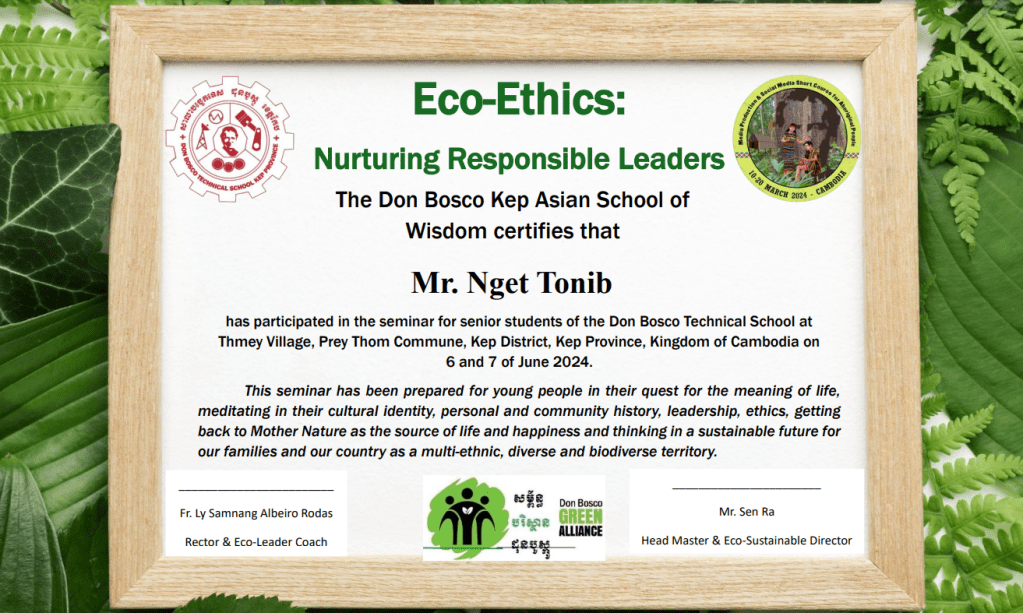
Kep Province —The Don Bosco Technical School of Kep Province celebrated its annual workshop for second-year students on 6-7 June 2024 under a new name: Eco-Ethics: Nurturing Responsible Leaders. Guided by Fr. Ly Samnang Albeiro Rodas, the Eco-Leader Coach, the school envisions an education that fosters critical thinking and encourages young people to be mindful of Mother Earth while honoring their ancestral traditions. This, they believe, is the true essence of education.
The workshop has been designed this year upon the inspiration on proposals by Fr. Niphot Thianwihan from the Chaing Mai’s Research and Training Centre for Religio-Cultural Community (RTCRCC) and from the film The Four Altars of the Peruvian singer songwriter Alonso del Río.
“In Chiang Mai, Thailand, Father Niphot has dedicated over 50 years to walking alongside indigenous peoples. He understands the necessity of listening to the voices of those who safeguard ancient traditions—the very traditions that can help address the global crisis caused by a technocracy obsessed with money, power, and vanity,” explains Albeiro Rodas. “Through his method of OI and courageous advocacy for the most vulnerable, indigenous communities like the Karen have transitioned from being recipients of aid to becoming donors. This commitment paves the way for new generations to reconnect with their ancestral roots and stand proudly in their identities.”
From the other side of the world, closer to his original peoples in South America, Albeiro Rodas was deeply moved by The Four Altars film. The movie critiques modern ways of life imposed by global powers, emphasizing materialism and the destruction of Mother Nature to sustain unsustainable practices. However, merely watching the film wasn’t enough. Albeiro delved deeper, exploring additional elements to grasp the proposed cosmology—largely rooted in our own ancestral traditions in South America. During this exploration, he discovered that Alonso del Río, whom he considers a great and inspiring artist, is actively involved in concrete actions. Del Río supports a school and protects a vast portion of the Amazon rainforest in Peru. Albeiro believes that many people in the realm of environmental protection merely engage in theories, beautiful speeches, and show business. However, Del Río’s proposals stand out because they are backed by real and impactful actions, such as establishing a school and safeguarding a protected forest.
Regarding education, Alonso del Río asserts that the modern system began to take shape in the early 20th century. During this period, influential figures like the United States’ barons—Rockefeller, JP Morgan, and other magnates—recognized that education could mold society. They swiftly gained control over major U.S. universities, leading to a symbiotic relationship between academia and pharmaceutical companies. This alliance birthed a lucrative business model: creating illnesses and then providing lifelong cures, effectively fostering addiction.
Unfortunately, universities ceased to be institutions where critical thinking was nurtured. Instead, they became cogs in a machinery that manufactured compliant individual’s tailor-made for the system. These pre-molded students lacked independent thought and merely served corporate interests. Over time, colleges mirrored this trend. Entrance into these universities often required conformity, resulting in the elimination of courses that encouraged critical thinking. These problematic dynamics have now permeated schools as well.
In our Don Bosco schools around the world, we anchor our education in what Don Bosco referred to as the Salesian preventive system. This approach extends beyond mere instruction aligned with societal expectations for workers; it encompasses a holistic life experience. Don Bosco aptly described it as creating ‘good citizens with excellent spiritual values.’ Albeiro Rodas now proposes a new phase of this preventive system, especially relevant in a time of profound changes—an era Pope Francis characterizes as not merely one of change, but a change of era itself (Aleteia, 2015).
Rodas emphasizes the need to rejuvenate the Salesian preventive system for our contemporary context. This rejuvenation demands a decisive shift, where both teachers and students actively engage with the challenges posed by our modern world. Importantly, we cannot limit our students to becoming cogs in systems that treat humanity as mere objects of manipulation. Instead, we must foster an education that connects them to their spiritual essence, transcending the mundane and drawing them closer to the divine. Albeiro Rodas’ vision aligns with the urgent call for transformative education—one that empowers students to navigate complexity, embrace their humanity, and contribute meaningfully to a changing world.
The workshop for students at Don Bosco Kep Technical School spanned two days, focusing on the theme of Eco-Ethics. Initially, participants explored fundamental questions: Who are we? Where do we come from? Why do our ancestors matter in our present time, contributing to our genuine and authentic happiness? Concurrently, they examined how modern technocracy seeks to erase our cultural identities, replacing them with a counterfeit world of pleasure—where happiness hinges on sex, money, and power,” explains Rodas.
The Don Bosco Kep Cultural Night and Bonfire gathering holds immense significance. Here, young individuals confront their roots—whether they identify as Khmer, Jarai, Kreng, Tham Puon, or Cham. They grapple with the complexities of community and the life choices they must embrace. Albeiro Rodas posed a poignant question to the 250 students studying electricity, media communication, secretarial work, and information technology: “While you study for a career, a job, and a salary—essential pursuits—remember that your true essence transcends these roles. As you age, society may discard you, but where truly lies your home?”
This introspective journey encourages students to connect with their inner selves, their heritage, and the profound purpose that extends beyond mere material existence.
On the second day of the workshop, two esteemed former students of Don Bosco in Cambodia served as guest lecturers: Mr. Pov Tula, the director of the Don Bosco Plan Development Office in Sihanoukville, and Mr. Try Seyha, the General Secretary of the Don Bosco Foundation of Cambodia in Phnom Penh. They shared their valuable experiences from working in various contexts—companies, organizations, and official departments—and emphasized the importance of ethical behavior rooted in spiritual values.
Their message transcends religious boundaries; it delves into the spiritual realm that extends beyond any specific faith tradition. As Fr. Niphot from Chiang Mai aptly puts it, understanding our true selves comes first. Then, echoing Alonso del Río’s wisdom, we awaken our consciousness to recognize the divine presence within us. In this profound journey, we discover that spirituality isn’t confined to religious labels—it’s about connecting with our inner essence, where God resides.
The insights shared by these former students underscore the holistic approach to education—one that nurtures both the mind and the spirit.
 Don Bosco Cambodia - DBFC