

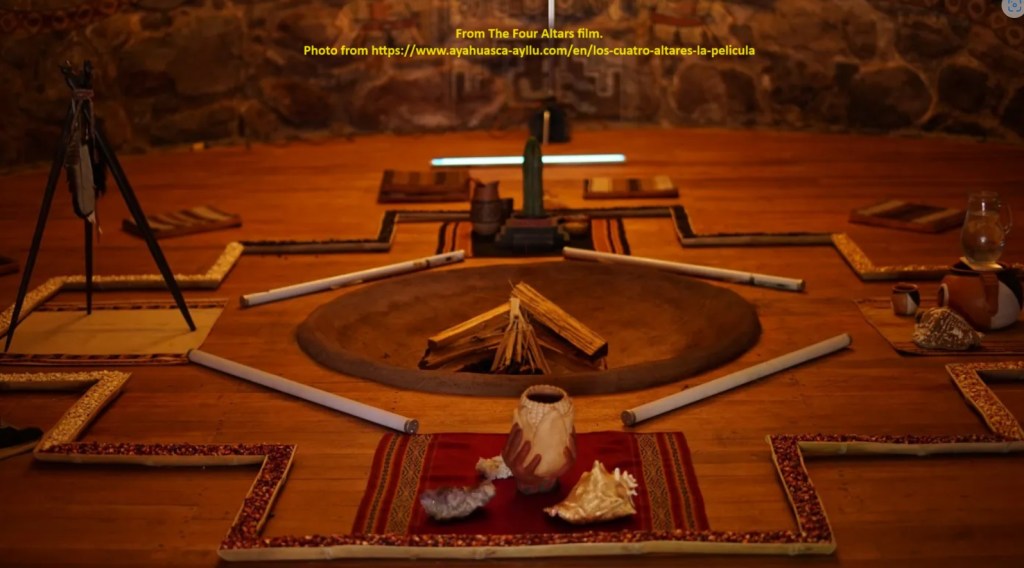
“The Four Altars Film,” entirely inspired by the book of the same name, represents a personal project by Alonso del Río—an artist who embarks on a life mission that transcends mere stages and fame. His art and music predominantly revolve around ancestral ceremonies involving healing plants in his native Peru. As the New Age movement gained momentum, so did the interest in ancestral indigenous traditions across both South and North America. People sought healing, recreation, and even enlightenment within this wave. It creates many negative impacts on indigenous communities and the use and abuse of sacred plants, brought out of their ethnical contexts, to fuel wrong ideas and manipulation like the so called “plastic-shamans.”
In contrast to Carlos Castañeda—a fellow Peruvian who captured the attention of American youth in the 1960s—Alonso del Río takes a different path. While Castañeda’s almost mythical Don Juan drew from indigenous cosmology to fuel the warrior’s quest for power, leaders like del Río work toward authentic awareness. For them, love stands as the ultimate reality, driving meaningful change and fostering compromise.
“From the perspective of the Four Altars, we perceive it as a sequence of evolutionary levels—a progression of consciousness. Religions occupy the space of the second altar, often rooted in pre-rational thought. Regardless of the specific religion—whether Judaism, Islam, Buddhism, Hinduism, or Christianity—dogmas persist. These dogmas are immovable, requiring acceptance without question,” says Alonso del Río in his review on contemporary religion and he continues: “While religious institutions have significantly shaped human evolution, they now pose a formidable barrier to progress. Moving beyond these somewhat primitive beliefs is essential for individuals to access new experiences and reconsider their concept of God.”
Th films invites us to read the books of Alonso del Río, since it belongs to a more complex process that involves the life and relations of the author with his community, the Peruvian indigenous cosmology and the activism to protect places like the Amazonian rainforest that is threatened by gold mine projects among others of deforestation.
Cultural diversity is indeed one of humanity’s most precious treasures, akin to the rich tapestry of life found in our ecosystems. “I believe that cultural diversity stands as one of humanity’s greatest riches, paralleling the biological diversity we find in nature. Our planet has evolved over 4.5 billion years to manifest the wonder it is today. Similarly, humans have undergone a 5-million-year journey, resulting in the creation of immense cultural wealth. Yet, amidst the rapid currents of globalization and neoliberalism, there exists a perilous trend—one that threatens to erase this heritage within mere decades,” says Del Río. “The urgency lies not only in what is at stake but also in the subtle nuances lost. The dominant logic often dismisses forms considered ‘primitive’ or those with alternative aesthetic values. In this struggle, indigenous peoples worldwide find themselves on the front lines, fighting for the survival of their cultures. Education, starting from schools, plays a pivotal role in preserving and celebrating this invaluable diversity,” he concludes.
I felt the need to ask to Del Río for what he would say to the Catholic Church, especially knowing his critical stance on religions and the absence of references from his part on efforts made by the synodal church promoted by Pope Francis, especially in actions such as Querida Amazonía, a synod that denounces the actions of the modern technocracy and the destructions not only of ecosystems but also indigenous peoples through violence, persecution and discrimination.
“What message would you convey to the Catholic Church? Perhaps a return to the original teachings of Jesus is in order. These teachings were fundamentally oriented toward compassion, service, and aiding the most vulnerable among us. Jesus never aligned himself with worldly power; quite the opposite. His voice resounded with unwavering criticism, denouncing the abuses of the Pharisees, scribes, and other religious and political figures of his time,” points out Del Río. “Imagine a Church that truly represents the interests of the people—one unallied with great economic powers and large corporations. To achieve this, perhaps a simple modulation of discourse suffices: a return to the core teachings of Jesus. These teachings, it seems, have been sidestepped and buried, likely because they challenge the comfort of those accustomed to luxuries and privileges.”
Welcome to watch The Four Altars that supports also education and environment in Peru.
 Don Bosco Cambodia - DBFC