

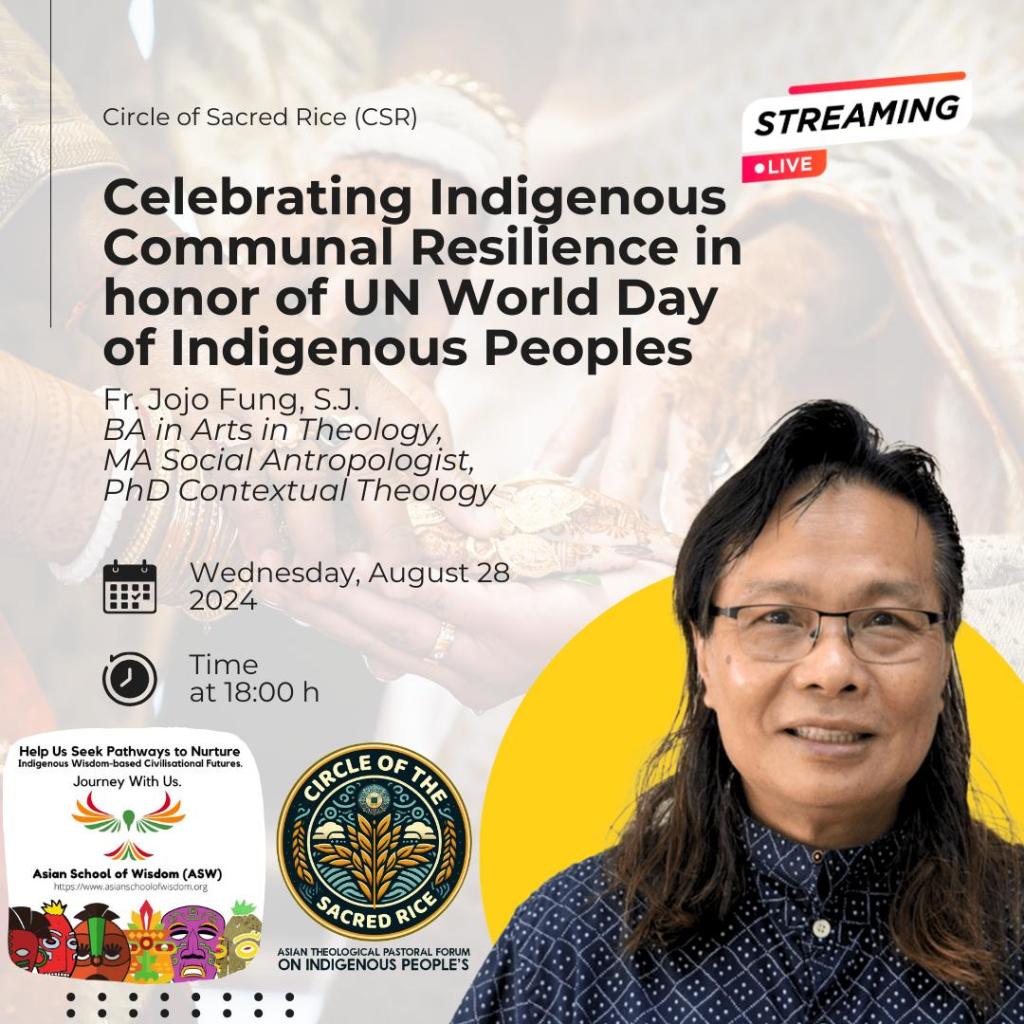
Don Bosco Kep Media — Fr. Jojo Fung, Jesuit and an expert in Asian Indigenous Theology, led the webinar “Celebrating Indigenous Communal Resilience in Honor of UN World Day Indigenous Peoples” organized by the Asian Theological Pastoral Forum on Indigenous Peoples (Circle of the Sacred Rice) and the Don Bosco Kep Media Communication Department.
The webinar was transmitted on 28th August 2024 at 18:00 Indochina Time with Fr. Jojo in Manila and presented by Fr. Albeiro Rodas in Cambodia and Mrs. Anne Lasimbang from PACOS Trust, a community-based organization (CBO) dedicated to supporting indigenous communities in Sabah, Malaysia.
9 August 2024 marked the 30th anniversary of the celebration of the UN International Day of Indigenous Peoples, a date that is getting much importance in a time where indigenous peoples are coming together to rise consciousness to the nations on the need to protect their identities, languages, traditions and rights, also in connection with the care for Mother Earth in a time of global climate change.
Fr. Jojo Fung, anthropologist, theologian and PdD in contextual theology, has visited almost every Asian country to know and relate directly with indigenous peoples in order to understand their knowledge and what it is important to share for a better balance between humanity and Creation. Resilience is one of those values linked to indigenous peoples, who through history, has been target of discrimination, persecution and forced cultural assimilation. The evidence of historical cultural heroes is one of those bases of resilience like the Murut warrior Antanom who fought the British in northern Borneo, being today a cultural reference for his descendants.
Communal Resilience becomes also a note of advocacy for land security and sovereignty against what is known as Green Colonialism, also known as eco-colonialism or environmental colonialism, in which environmental policies and projects, often initiated by countries in the Global North, can negatively impact Indigenous peoples and communities in the Global South. This concept highlights how efforts to combat climate change and promote sustainability can sometimes perpetuate historical patterns of exploitation and inequality. For example, the establishment of renewable energy projects, such as wind farms or lithium mining for electric car batteries, can lead to the displacement of Indigenous communities and the disruption of their traditional ways of life. These projects are often implemented without the consent of the affected communities, violating their rights and exacerbating existing vulnerabilities. To address green colonialism, it is crucial to prioritize Indigenous rights and knowledge in climate change policies and projects. This involves ensuring that Indigenous communities have a say in the development and implementation of environmental initiatives and that their land and resources are protected.
The revival of indigenous languages is one way of resilience and the rescue of ancient wisdoms that we need today in the global climate crisis., because resilience is rooted in nature. For example, for the Bodos, a group of peoples speaking Tibeto-Burman languages in the northeastern Indian states of Assam and Meghalaya and in Bangladesh, life is not possible without nature, and we anger the gods when we destroy Mother Earth.
Indigenous perspectives of Mother Nature, allowed that many indigenous communities could be protected during the covid pandemic, when they applied their ancestral rituals, like the Karen people of Chiang Mai, Thailand, celebrating their ancient ritual “Kroh Yee” that means “closure of the village.” But the indigenous peoples, in order to preserve their languages and traditions, need assurances to their ancestral territories. Like Macli-ing Dulag, the “Defender of the Cordillera” in northern Philippines, said: “Only the race (community) owns the land, because the race lives together” in reply to those who, with arrogance, wanted to request from his people the property titles to prove ownership over the land.
A different approach must come in relation to the deep meanings of ancient indigenous traditions that have been hold as “paganism, barbarian, savage, ignorant and even diabolic” by colonial western powers throughout history. The understanding of those ancient traditions holds keys of wisdom that would bring peace and understanding over all peoples, being tolerant and supportive, especially for those who are more vulnerable. In Querida Amazonía (QA) No. 79 it is written:
“It is possible to take up an indigenous symbol in some way, without necessarily considering it as idolatry. A myth charged with spiritual meaning can be used to advantage and not always considered a pagan error. Some religious festivals have a sacred meaning and are occasions for gathering and fraternity, albeit in need of a gradual process of purification or maturation.”
QA underlines that our modern societies have much to learn from indigenous peoples, especially values such as personal, familial, communal and cosmic harmony “and finds expression in a communitarian approach to existence, the ability to find joy and fulfillment in an austere and simple life, and a responsible care of nature that preserves resources for future generations, joyful sobriety be content with little; they enjoy God’s little gifts without accumulating great possessions; they do not destroy things needlessly; they care for ecosystems and they recognize that the earth, while serving as a generous source of support for their life, also has a maternal dimension that evokes respect and tender love”.
In this way we marked the 30th anniversary of the celebration of the Indigenous Peoples Day. In three decades, many things have happened around the world, emphasizing in technocracies and consumerism. We do not point out technologies and development initiatives as negative things. Every human progress is an opportunity, and it is also a world heritage. But humanity is diversity that means wisdoms and cultural richness. Indigenous peoples, in particular, are the descendants of very ancient peoples, who have been able to resist centuries, preserving ancient wisdoms that we need today.
 Don Bosco Cambodia - DBFC