

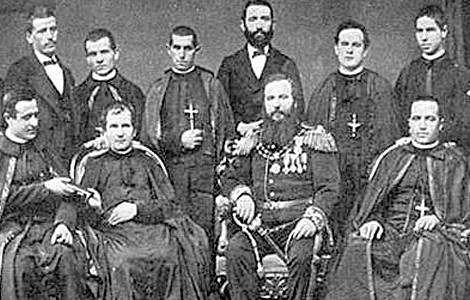
- Salesians ask for forgiveness for historical mistakes with Indigenous Peoples.
- “We have not always made explicit the tragedy that the native peoples experienced,” noted the Argentinian Salesian Superior.
- The Superior invites for a re-launching of the Missions to be in tune with history.
Buenos Aires — The Salesian Superior of Argentina, Fr. Dario Perera, inaugurated the anniversary commemoration of the arrival of the Salesians of Don Bosco to Argentina 150 years ago. This process was personally encouraged by Saint John Bosco, founder of the original Italian religious order, who sent the first missionaries on December 14, 1875, from the Church of Mary Help of Christians in Valdocco, Turin, Italy. Fr. Perera presided over the Eucharist at the Mater Misericordiae Church in Buenos Aires, the same arrival point of the Italian missionaries of the time. Don Bosco was personally interested in the pastoral accompaniment of Italian migrants to the southern South American country at the end of the 19th century, with special attention to the evangelization of aboriginal peoples in vast regions such as La Pampa and Tierra del Fuego, which includes territories in the Republic of Chile and touches the Antarctic Circle, made famous by the ancient exploration of Ferdinand Magellan.
However, the south of the Abya Yala continent – as contemporary Indigenous nations refer to South and North America today – was not only of interest to missionaries. After the independence of most Hispanic Latin American countries from the Spanish Empire during the first part of the 19th century, the mostly white and mestizo elites continued the expansion of Western paradigms of what was understood as “the only civilization” and the dispossession of ancestral territories from the hands of the aboriginal peoples. History today highlights the massacres and genocides of entire Indigenous populations from Argentina, Chile, and Brazil to Mexico during the following decades of independence and the marginalization of Indigenous and Afro-American populations.
In his homily for the official opening of the anniversary events, Fr. Dario Perera called for a year to recognize, rethink, and relaunch the Salesian Missions worldwide, following the spiritual invitation of former Salesian Rector Major Fr. Ángel Fernández Artime. “We cannot deny that we arrived in Patagonia together with the army in the context of military campaigns. It is true that the missionaries were critical and found themselves in the dilemma of going to save what they could. And it is no less true that their presence alleviated, as much as possible, the pain of those who were being abused. In addition, the atrocities committed are largely known today because they were denounced and documented by the missionaries themselves. Even so, it hurts us and it is necessary to recognize that we arrived with the great victimizers of the native peoples,” he said during his homily. He continued: “It is necessary to recognize that many times, even wanting to do good, one ends up doing harm. 150 years ago, the conviction in the Christian West was that the best we could offer to cultures considered ‘less developed’ was to incorporate them into Western civilization. This conviction was hardly disputed by anyone, and we assumed it in our evangelizing task, which brought about the weakening and even disappearance of their own cultural wealth. In a certain way, we have been participants in a process of cultural homogenization for which we need to ask forgiveness. It is true that the missionaries contributed a lot to the care and recovery of a key tool of cultural identity such as the language of these peoples, but we cannot deny the homogenizing imprint that our educational-pastoral work has often had.”
Fr. Perera underlined the historical facts of the missionary actions of the Daughters of Mary Help of Christians, or Salesian sisters, in South America, who were brave enough to defend the rights of the most vulnerable. “For helping to preserve and develop the cultural heritage of the Indigenous peoples; for the commitment to education and promotion in all fields (even in health); for risking their lives with courage and bravery for those to whom they were sent; because they did not lack courage to denounce on numerous occasions the genocide that the national government was carrying out at that time through a militaristic campaign that sought to make invisible in order to exterminate,” he mentioned.
The Salesians have been associated with Indigenous peoples throughout the Western Hemisphere, from Canada to Tierra del Fuego, during 150 years of missionary actions. “The dynamics of history make it essential that we embrace it in all its complexity, contemplating not only its lights but also humbly and wisely recognizing its shadows,” he said. During these 150 years, only three Indigenous persons associated with Salesian missions in the Americas have been recognized for their holiness: Blessed Ceferino Namuncurá, an Argentinian Mapuche boy who became a Salesian but died at the age of 19 in Rome; Blessed Laura Vicuña, a mestizo Chilean girl who died at the age of 13 and was a student of the Salesian sisters; and the Brazilian Bororo Indigenous man, Servant of God and Martyr Simão Bororo, who was a catechist at the Salesian mission of his community and who died defending German Fr. Rudolf Lunkenbein. Both are in the process of beatification for martyrdom. Out of these three natives, 150 years seems to be a short time to discover Indigenous holiness, even if 70% of Christians worldwide are Indigenous peoples and most of them are in Latin America. In five centuries of exploitation, discrimination, and persecution, Indigenous peoples have shown resilience and martyrdom. However, as Fr. Perera points out in his homily, for centuries the Catholic missions were dedicated to leading acculturation processes where Indigenous, native, and Afro-American faithful were considered “third-class Christians.” Cases like Saint Martin de Porres in Peru, an Afro-mestizo man who joined the Dominicans as a lay brother, was canonized in 1837 by the force of popular veneration. Even the face of the mestizo Blessed Laura Vicuña was presented for decades as an Italian girl until her photo was discovered in old archives, revealing her Indigenous makeup.
Inspired by Querida Amazonia and the synodal Church, the Jubilee 2025 as Pilgrims of Hope, and the Strenna 2025 Anchored in Hope, Pilgrims with Young People, we place the 150 years of Salesian Missions within that context of hope and journeying, recognizing historical events and purifying intentions and spirituality. Journeying with Indigenous Peoples is not a situation of patronizing or thinking that somebody is the owner of the Gospel and that the Gospel is rooted in a particular culture, but it belongs to the Most High, the Great Spirit, the Creator of people, the owner of closeness and immediacy, the owner of Heaven and the owner of the Earth, like Our Lady Coatlalopeuh announced to Santo Cuauhtlatoatzin in Tepeyac.
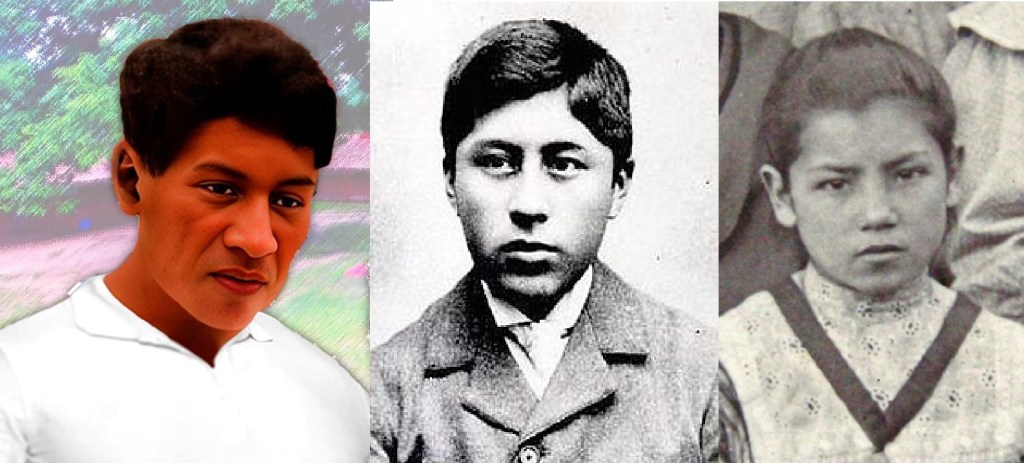
Although 70% of Christians worldwide are Indigenous people, the number of Indigenous saints is minimum. Like Matthew Fox in his work “The Original Blessings” writes: “From the 10th to the 20th century the Catholic Church has canonized 351 men and 75 women (a ratio of 82 percent to 18 percent); in the same period it has canonized 332 clerics and 81 lay people (a ratio of 81 percent to 19 percent). Among the anonymized lay people, only a few were married. The last lay person to be canonized, G. Moscati, who was beatified by Paul VI, was celibate!” (Fox Matthew, 1983, p. 336.)
You can be interested to read also:
- Homily at the beginning of the 150 years of the Salesian Missions Provincial Fr. Darío Perera SDB.
- Querida Amazonia (English).
- Laudato Deum.
- Laudato Si´.
- Argentina – Celebrations begin for the 150th anniversary of the First Salesian Missionary Expedition.
- Asian Forum on Celebrating Synodality and Indigenous Living Traditions in the Church in Asia.
- Declaration of the Young Asian Indigenous Peoples.
- Namuncurá Film Festival for Asian Indigenous Youth.
- Indian bishop spotlights shortcomings in Asian Church’s approach to Indigenous Peoples.
 Don Bosco Cambodia - DBFC